0
Understanding Magic Mushroom Grow Kits, Psilocybin Research, Global Legality, and Safe Mycology Practices
Magic mushrooms have been studied for decades due to their unique biological properties and the growing scientific interest in psilocybin, the naturally occurring compound responsible for their psychoactive effects. While many people encounter these fungi through cultural references or research publications, the science behind their growth, structure, and effects is often misunderstood. This educational guide brings together four essential knowledge areas: the biology of magic mushrooms, the science behind grow kits, the global legal landscape, and harm-reduction principles supported in scientific literature. Understanding Magic Mushroom Grow Kits, Psilocybin Research, Global Legality, and Safe Mycology Practices. Psilocybin Legality Europe Guide.
For readers interested in further educational materials on mycology, responsible information, and research-focused discussions, an additional resource can be found at psilocybinuk.com (anchor link included for informational purposes only).
1. The Mycology of Psilocybin Mushrooms: Biology, Taxonomy, and Growth Cycle
Magic mushrooms belong primarily to the Psilocybe genus, though psilocybin can be found in species within the genera Panaeolus, Gymnopilus, and Inocybe. One of the most well-known species is Psilocybe cubensis, valued in research for its consistent morphology and well-documented growth patterns. Another species, Psilocybe semilanceata—often called Liberty Caps—is recognized for its distinctive conical cap and its widespread natural presence in temperate regions. Psilocybin Legality Europe Guide.
Growth Cycle Overview
The growth of these fungi follows a structured biological timeline:
Spore Stage
The life cycle begins with microscopic spores containing the genetic blueprint of the organism. Spores germinate under humid, sterile, and nutrient-rich conditions.
Mycelium Formation
Germinated spores develop into mycelium, a white, thread-like network that digests nutrients and colonizes the substrate. In natural ecosystems, mycelium plays a crucial role in decomposing organic matter.
Primordia (Pinning)
Under appropriate humidity, temperature, and airflow, the mycelium begins forming tiny knots known as pins or primordia.
Fruiting Bodies
These primordia develop into mature mushrooms containing psilocybin and related tryptamine alkaloids. Environmental factors such as light exposure and moisture strongly influence size and shape.
Understanding this process helps researchers, students, and enthusiasts appreciate the complexity of fungal biology without engaging in prohibited cultivation activities.
2. How Grow Kits Work (Scientific and Educational Overview)
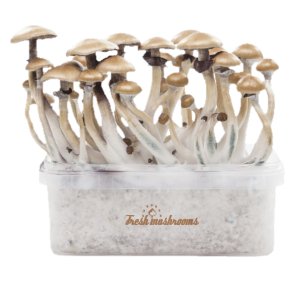
Grow kits are commonly referenced in academic and mycology discussions because they demonstrate the full fungal life cycle in a controlled environment. A grow kit typically includes:
- A prepared substrate (grain, vermiculite, or a nutrient blend)
- Fully colonized mycelium
- Filtered air-exchange points
- Humidity and temperature control instructions
From an educational standpoint, these kits help illustrate:
- How mycelium consumes nutrients
- How moisture gradients affect the fruiting stage
- How environmental cues trigger vegetative vs. reproductive growth
- The differences between species phenotypes, such as Liberty Caps vs. Cubensis
- The importance of sterile technique in fungal culturing
While these systems are used in laboratory conditions to study fungal life cycles, it is important to note that in many countries, the cultivation of psilocybin-containing mushrooms is regulated or prohibited.
3. Legal Status of Psilocybin in Europe, the UK, and Globally (Educational Summary)
Laws surrounding psilocybin vary significantly by jurisdiction. Understanding these distinctions is essential for anyone studying or researching the subject.
United Kingdom
Psilocybin is classified as a Class A substance, making cultivation, possession, and distribution illegal without an approved research license. Liberty Caps grow naturally in the UK, but their harvest or use for psychoactive purposes is prohibited.
Europe
- Netherlands: Fresh “truffles” (sclerotia) remain legal for sale; psilocybin mushrooms are not.
- Germany, France, Italy, Spain, Sweden: Psilocybin is controlled; regulations differ regarding grow kits or spores.
- Portugal: Decriminalization of personal quantities does not equate to legalization of cultivation.
North America
- Canada: Legal medical exemptions exist for certain therapeutic cases, but recreational use remains illegal.
- United States: Federally illegal; however, some cities and states have decriminalized personal possession.
Asia, Middle East, Africa
Most jurisdictions classify psilocybin as a controlled substance. Research exemptions are sometimes available with strict licensing.
Because laws change rapidly, readers researching this topic should refer to official regulatory sources for current updates.
4. Harm-Reduction Principles and Safety Considerations
Educational material about psilocybin must include harm-reduction guidance, as outlined by public health research organizations. Key considerations include:
Accurate Identification
Many toxic mushroom species resemble psilocybin-containing varieties. Mycological misidentification can lead to severe poisoning.
Set and Setting
Scientific literature shows that psychological environment strongly affects outcomes in psilocybin studies. Unsafe environments increase risks of anxiety, panic, or disorientation.
Interactions and Contraindications
Psilocybin may interact with:
- SSRIs
- MAOIs
- Antipsychotics
- Cardiovascular medications
Individuals with a history of psychosis, bipolar disorder, or severe anxiety disorders are typically excluded from clinical trials.
Dosage Variability
Concentrations of psilocybin vary by species, phenotype, and growing conditions. Without laboratory testing, exact amounts cannot be determined.
Post-Experience Integration
Research-based therapy models include structured reflection to reduce psychological distress and encourage measured interpretation of the experience.
This information is presented for educational purposes, supporting informed, safe, and responsible understanding based on evidence from clinical and academic studies. Psilocybin Legality Europe Guide.
Conclusion
Magic mushroom grow kits, psilocybin research, harm-reduction principles, and global regulations form an interconnected landscape that requires clarity and responsible education. By understanding the biological foundations of psilocybin mushrooms, their legal context, and the safety frameworks used in clinical research, readers are better equipped to navigate this complex subject responsibly. Additional educational resources and neutral information can be found at psilocybinuk.com. Understanding Magic Mushroom Grow Kits.